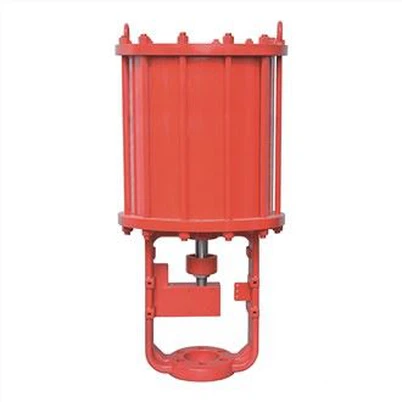
Analysis of operating principle of pneumatic film regulating valve
Leave a message
The development of pneumatic film regulating valve since the beginning of the 20th century has been 80 years of history, has produced ten categories of regulating valve products, self-operated valves and positioners, etc., the development of regulating valves and control valves is as follows:
1920s: The original regulating valve for stable pressure was introduced.
1930s: The "V" type notched two-seat valve and single-seat valve as the representative product V-type regulating ball valve came out.
1940s: Positioner appeared, new varieties of regulating valves were further produced, diaphragm valves, Angle valves, butterfly valves, ball valves and so on.
1950s: Ball valves were widely used, and three-way valves were put into the system instead of two single-seat valves.
1960s: After the series of improvement design and standardization and standardization of the above products in China, there was a complete series of products in China. Now we are still in the use of a large number of single-seat valves, two-seat valves, Angle valves, three-way valves, diaphragm valves, butterfly valves, ball valves seven products are still the level of products in the 1960s. At this time, foreign countries began to introduce the eighth kind of structural control valve - sleeve valve.
1970s: Another new structure of the product - eccentric rotary valve came out (the ninth category of structure of the regulating valve variety). During this period, sleeve valves were widely used abroad. At the end of the 1970s, the sleeve valve was jointly designed in China, so that China has its own sleeve valve product series.
1980s: During the reform and opening up period, China successfully introduced petrochemical equipment and regulating valve technology, so that sleeve valves and eccentric rotary valves have been promoted and used, especially sleeve valves, which have the potential to replace single and two-seat valves, and their use is more and more widespread. At the end of the 1980s, another major progress in regulating valves is Japan's Cv3000 and fine small regulating valves, which in terms of structure, change the pneumatic film actuator of a single spring to a multi-spring film actuator, and the structure of the valve is only improved, not changed. Its outstanding feature is to reduce the weight and height of the regulating valve by 30%, and increase the flow coefficient by 30%.
90's: 90's control valve is in the reliability, special difficult products research, improvement, improvement. By the end of the 1990s, the tenth structure of the product was introduced by the Hualin company - the full-function ultra-light valve. It is characterized by breakthroughs in reliability, function and weight. Functional breakthrough - with full functional products, therefore, a product can replace many functional incomplete products, so that the selection is simplified, the use of simplified, simplified varieties; Breakthrough in weight - 70 ~ 80% lighter than the leading products single-seat valve, two-seat valve, sleeve valve, 40 ~ 50% lighter than fine small valve; Reliability breakthrough - solve the traditional control valve and other unreliability factors, such as seal reliability, positioning reliability, action reliability. The advent of the product, so that China's control valve technology and application level reached the level of the late 1990s; It is a major breakthrough for the regulating valve; In particular, the electronic full-function ultra-light valve will become the mainstream of regulating valves in the next century.