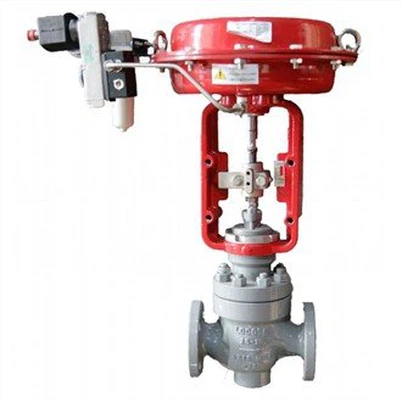
What problems should be paid attention to when selecting a pneumatic control valve?
Leave a message
There is not much difference between pneumatic control valve and electric control valve, but the actuator is different. The former requires a compressed air source, while the latter requires only a power supply, which is more convenient. Pneumatic control valves need to be equipped with compressors and other equipment, which have the advantages of explosion-proof function, simple maintenance and low failure rate. Therefore, in chemical, petrochemical and other industries, its application range is much larger than that of electric control valves.
According to different structural forms, pneumatic control valves can be divided into pneumatic single-seat control valves, pneumatic sleeve control valves, pneumatic double-seat control valves, pneumatic three-way control valves, pneumatic cage control valves, pneumatic angle control valves, pneumatic V control valves Type regulating ball valve, pneumatic butterfly valve and other categories. The prepared actuators mainly include membrane type and piston type, among which the control precision of membrane type actuator is slightly higher than that of piston type actuator. According to the difference of the distribution valve positioner, it can be divided into two types: mechanical type and intelligent type. The intelligent control precision is higher than that of the mechanical type.
Depending on the medium, the valve body material also has different options. Commonly used carbon steel, corrosive stainless steel, 304 or 316, 316L and other materials can also choose fluorine lined control valve. There are also several special pneumatic control valves: low temperature control valve, high temperature control valve, high pressure control valve, small flow control valve, etc. A single regulator valve is used for operating conditions where the differential pressure is relatively small. Once the differential pressure is relatively large, a sleeve regulating valve or a double seat regulating valve can be selected. Because the leakage of the double-seat control valve is relatively large and the leakage is small, it is not suitable to choose a double-seat control valve.
Three-way regulating valve is used to combine two fluids into one or two fluids. For the occasions where the pressure difference is particularly large and is prone to cavitation or flash evaporation, a multi-stage cage regulating valve can be selected to depressurize the high-pressure fluid in stages to achieve stable control. Pneumatic V-type regulating ball valve is suitable for media containing particulate debris, such as pulp and so on. Since the inner parts of the valve are sheared left and right, its flow characteristics are close to equal percentages, and the adjustable ratio is much larger than that of ordinary single-seat and sleeve control valves, so the application range is becoming wider and wider. Electric regulating butterfly valve is more suitable for large diameter occasions, and the cost performance is higher.
All in all, users should choose the pneumatic control valve correctly according to their actual needs to achieve good results.